Instant feeder switching
Two separate feeders allow material changeover. The supplied sheet describes reinforced feeder locks for a secure connection.
WORKSHOP · TWO FEEDERS · AUTOMATION
A 15 kg low-pressure cold spray platform with two powder feeders and instant switching. Designed for manual use or integration into automated and robotic systems.
DESIGNED FOR YOUR WORKFLOW
Two separate feeders allow material changeover. The supplied sheet describes reinforced feeder locks for a secure connection.
A front-panel display shows gas temperature. A smooth voltage regulator allows fine temperature adjustment, with gas heating up to 600 °C.
An LED on the spray gun improves visibility of the work area, particularly when access is restricted.
The specification lists storage for nozzle components and silicone feed tubing, a funnel holder and a cleaning pin.
A control cable interface supports integration work. Confirm signals, interlocks and control requirements for the planned cell.
The supplied sheet describes modular electrical construction and accessible internal components for maintenance.
A CLOSER LOOK
System render and equipment detail photographs.
Select a photograph to enlarge it.
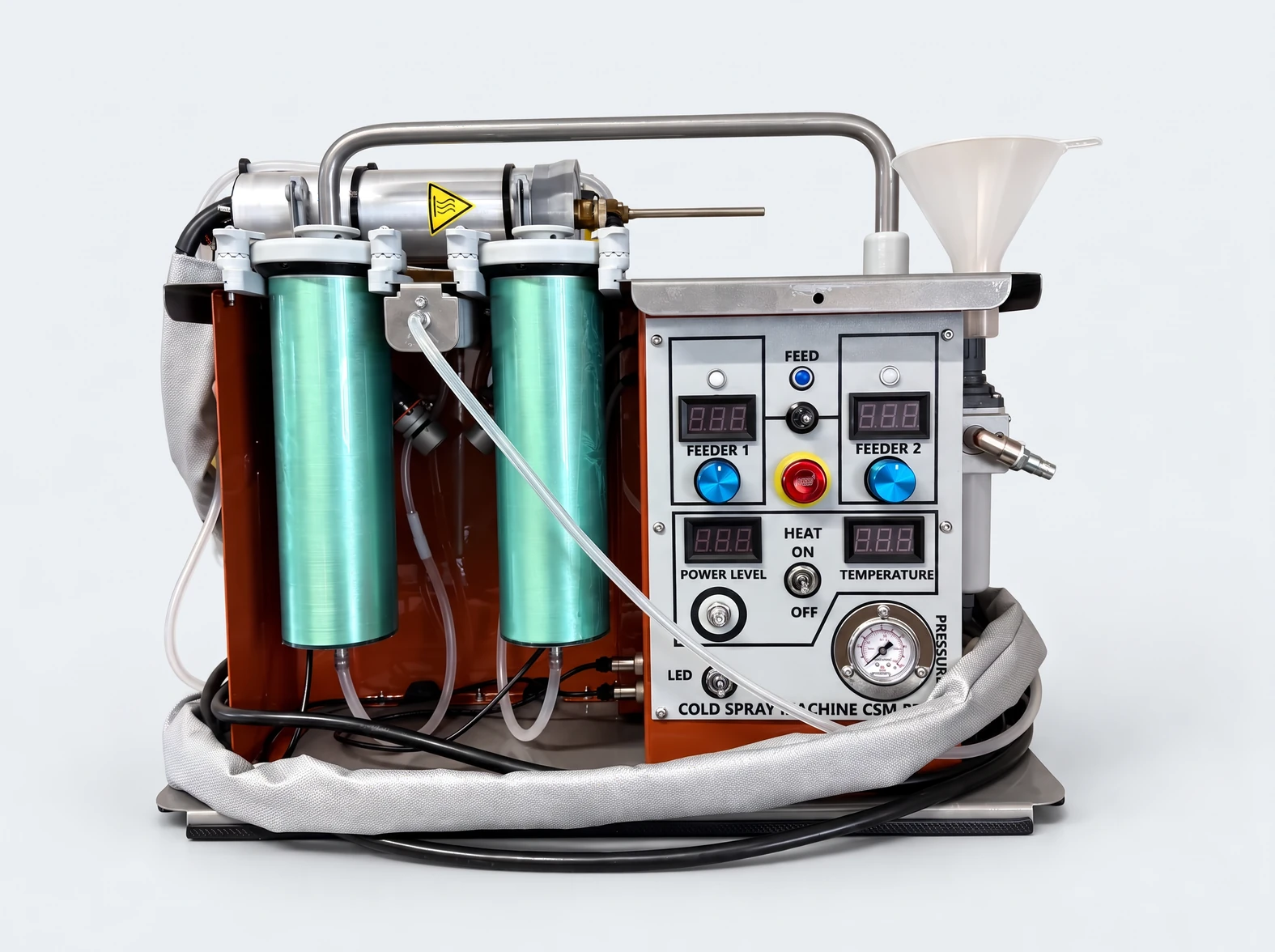
Two powder feeders, front controls and the handheld spray gun in one workshop platform.
The front panel brings powder feed, heating and pressure controls together. Display readings in this photograph are illustrative, not recommended process settings.
A closer look at the feeder body and locking arrangement. Prepare material changes using the specified handling and cleaning procedure.
The gun-mounted LED illuminates the nozzle and working area.
The rear of the unit shows the equipment enclosure, cable routing and hose arrangement.
Side-mounted storage and a cleaning tool keep service items close to the equipment.
TECHNICAL DATA
Equipment data are the starting point. Confirm the supplied configuration and validate your process before production.
9 bar is the owner-confirmed maximum inlet pressure. The source sheets contain an incorrect psi conversion; it is not repeated here.
200–600 °C refers to gas at the nozzle inlet, not the component or particle temperature.
The published noise and warm-up figures are specification statements, not guarantees for every installation. Assess the actual workplace.
| Powder feeders | 2, instant switching |
|---|---|
| Operation | Manual / automated / robotic integration |
| Total equipment mass | 15 kg |
| Spray gun mass, including 2.1 m protective sleeve | 2.1 kg |
| Assembly dimensions | Rack assembly: 550 × 440 × 280 mm |
| Spray gun with nozzle | 485 × 65 mm |
| Spray gun without nozzle | 355 × 65 mm |
| Maximum inlet air pressure | 9 bar |
| Operating air pressure | 5–8 bar |
| Compressed air consumption | 0.4 m³/min |
| Gas temperature at nozzle inlet | 200–600 °C |
| Single-phase AC supply | 210–240 V, 50–60 Hz |
| Maximum electrical consumption | 3.3 kW |
| Powder consumption | 0.1–0.8 g/s |
| Time to operating condition | No more than 10 seconds (specified) |
| Noise stated in specification | No more than 75 dB without shielded box; test conditions not supplied |
IS THIS THE RIGHT PLATFORM?
Consider CSM270 for workshop work, frequent powder changes, controlled development trials or planned automation. Integration must address part handling, motion, extraction and process monitoring.
The supplied specification lists aluminium, zinc, copper, nickel, tin and lead deposition families. Actual suitability depends on the selected grade, substrate and nozzle. Lead-containing materials need particular handling controls.
Potential work includes local restoration, conductive layers and surface protection. Ceramic, glass and polymer substrates need dedicated trials; the model name alone does not establish adhesion or service performance.
Find a powder by composition and purposeCheck clean, dry air delivered at operating pressure; electrical supply; dust containment and extraction; operator protection; surface preparation; nozzle access; finishing and acceptance tests.
Do not infer electrical insulation from a metallic layer, or structural repair approval from successful deposition.
Send the substrate, dimensions, required result and a drawing or photograph.