Two powder feeders
The separate powder multistation accommodates two feeders. Confirm the supplied nozzle and powder-feed configuration for your task.
PORTABLE · MANUAL · TWO FEEDERS
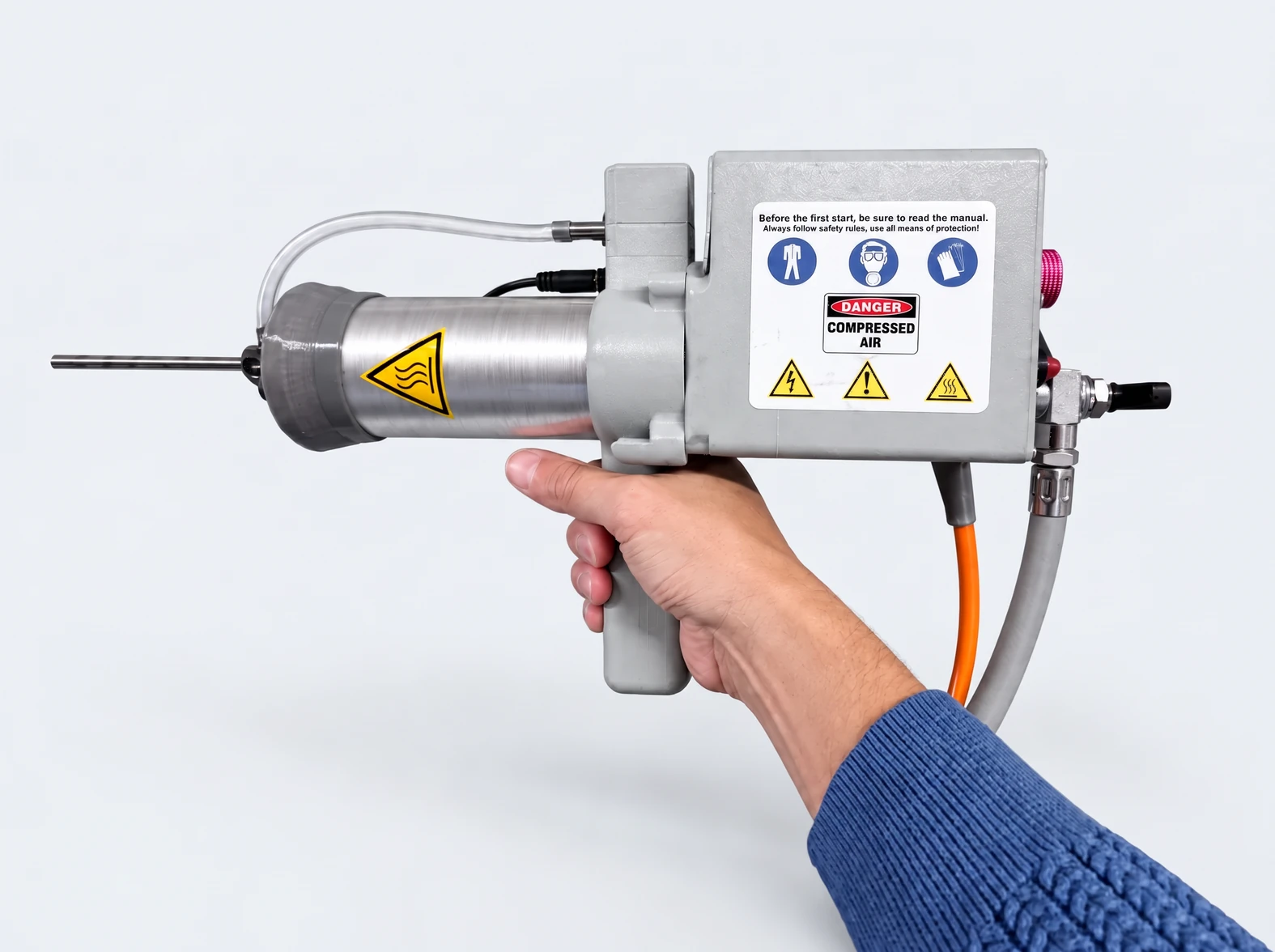
A portable low-pressure cold spray system for manually applied metal coatings and abrasive surface preparation. The specified total equipment mass is 3.4 kg, with a separate two-feeder powder station.
FILMED WORKSHOP CASE / CSM360
Watch the operator work on a hydraulic cylinder rod, inspect the treated area up close and hand-finish the local repair.
Manual passes place material in the selected repair area.
The camera shows the treated area before finishing.
The second clip shows mechanical dressing of the local surface.
A workshop repair sequence on the component shown. Powder grade, final surface roughness, dimensional checks, adhesion results and service testing are not documented in these clips. Return to service requires the component’s agreed inspection and acceptance procedure.
FILMED WORKSHOP CASE / CSM360
A 39-second edit of work on a lower rear body panel: surface preparation, a change at the two-feeder powder station and manual zinc deposition.
The operator treats the exposed area along the lower panel before coating.
The film shows the operator moving to the two-feeder CSM360 station and changing the feed selection.
Manual passes cover the prepared area. Zinc is the material identified by the owner for this footage.
The film documents the visible workshop sequence. It does not provide the zinc powder grade, coating thickness, adhesion, corrosion-test results or an approved body-repair procedure. Vehicle corrosion protection and repair suitability must be verified on the actual panel and service conditions.
DESIGNED FOR YOUR WORKFLOW
The separate powder multistation accommodates two feeders. Confirm the supplied nozzle and powder-feed configuration for your task.
The specification gives a gun mass of 1.9 kg including the 2.1 m protective sleeve, and a 65 mm gun diameter.
The specification covers metal deposition and sand-blasting capability. Use the appropriate abrasive or deposition powder and nozzle setup.
A small equipment footprint supports transport between jobs. Compressed air, electrical power and suitable dust control are still required.
TECHNICAL DATA
Equipment data are the starting point. Confirm the supplied configuration and validate your process before production.
9 bar is the owner-confirmed maximum inlet pressure. The source sheets contain an incorrect psi conversion; it is not repeated here.
200–600 °C refers to gas at the nozzle inlet, not the component or particle temperature.
The published noise and warm-up figures are specification statements, not guarantees for every installation. Assess the actual workplace.
| Powder feeders | 2 |
|---|---|
| Operation | Manual |
| Total equipment mass | 3.4 kg |
| Spray gun mass, including 2.1 m protective sleeve | 1.9 kg |
| Assembly dimensions | Powder station: 200 × 200 × 60 mm |
| Spray gun with nozzle | 510 × 240 × 75 mm |
| Spray gun without nozzle | 373 × 240 × 75 mm |
| Spray gun diameter | 65 mm |
| Maximum inlet air pressure | 9 bar |
| Operating air pressure | 5–8 bar |
| Compressed air consumption | 0.4 m³/min |
| Gas temperature at nozzle inlet | 200–600 °C |
| Single-phase AC supply | 210–230 V, 50–60 Hz |
| Maximum electrical consumption | 3.3 kW |
| Powder consumption | 0.1–0.8 g/s |
| Time to operating condition | No more than 10 seconds (specified) |
| Noise stated in specification | No more than 75 dB without shielded box; test conditions not supplied |
IS THIS THE RIGHT PLATFORM?
Consider CSM360 when manual access and portability matter more than a fixed workshop station. Describe the part geometry and operator reach before selecting the nozzle.
The supplied specification lists aluminium, zinc, copper, nickel, tin and lead deposition families. Actual suitability depends on the selected grade, substrate and nozzle. Lead-containing materials need particular handling controls.
Potential work includes local restoration, conductive layers and surface protection. Ceramic, glass and polymer substrates need dedicated trials; the model name alone does not establish adhesion or service performance.
Find a powder by composition and purposeCheck clean, dry air delivered at operating pressure; electrical supply; dust containment and extraction; operator protection; surface preparation; nozzle access; finishing and acceptance tests.
Do not infer electrical insulation from a metallic layer, or structural repair approval from successful deposition.
Send the substrate, dimensions, required result and a drawing or photograph.